
Unfolding a Ritual: Modern Panchakarma Rooted in Ancient Tradition
A Portrait of Corinna Maharani, Founder and Lead Practitioner at the Maharani Academy
CAAM caught up with Corinna Maharani while she was abroad in the Netherlands, teaching Panchakarma to a new group of students, a fitting backdrop for a practitioner whose work has always lived at the intersection of ancient ritual and modern life. Corinna is the founder of the Maharani Academy in Santa Barbara, California, where she has spent decades refining the American application of classical teachings passed down by her Guru, Vaidya R.K. Mishra.
At her Santa Barbara spa clinic and training academy, Corinna drawing on the guidance of her teacher, developed a distinctly American adaptation of Panchakarma, one built around the recognition that Western bodies carry different imbalances than the bodies traditionally treated in India. Her approach bridges classical knowledge with a clear-eyed understanding of modern chemical, environmental, and emotional stressors. And true to the heart of Ayurveda, she meets each person exactly where they are, favoring deep one-on-one relationships over generalized treatment. Today, the Maharani Academy runs a hybrid training program that blends online coursework with live, hands-on instruction across France, the Netherlands, Germany, and the United States.
Finding the Path
Corinna's path to Ayurveda began in her early twenties, drawn in by the teachings of Maharishi Mahesh Yogi, who had first carried Ayurveda and Transcendental Meditation into the Western world in the late 1960s and early '70s. In 1988, she arrived at Maharishi International University in Fairfield, Iowa, to study in one of the country's first formal Ayurvedic programs.
She was pulled toward Panchakarma almost immediately. It struck her, she says, at the level of the heart, something about the way it honored a person's uniqueness and energetics spoke to her directly. Like so many who find this path, it felt less like discovery and more like remembering. She had arrived as a young person searching for something she couldn't yet name, and Ayurveda helped her understand exactly what that search had been about. Even now, decades later, she describes the medicine as fundamentally empowering, a practice that guides a person back to the understanding of who they are.
For more than twenty years, Corinna studied as a senior student of the revered Vaidya R.K. Mishra, a healer born into a family of Raj Vaidyas whose lineage stretches back five thousand years, documented in the ancient Vedic Puranas. Vaidya Mishra carried that unbroken tradition forward himself, translating the classical Sanskrit texts into English and ensuring his practitioners were firmly rooted in the pure tradition before them.
Though he was, first and foremost, a traditional Indian healer, he devoted much of his life to education and research. Through his own discoveries, he came to redefine what treating and healing meant for a modern society, with a particular focus on gently removing the toxins from the patient. Corinna continues to draw those same principles in her own practice today.
Corinna didn't set out to become an educator, it happened almost by chance. About twenty years ago, a group of students approached her and asked if she would put together a course on Panchakarma. That request eventually led to a fifteen-year teaching post at Kanyakumari, a school in Wisconsin. It was there that she and her fellow teachers ran into a modern idea, the old, classical way of teaching Panchakarma didn't translate cleanly to Western bodies. Vaidya Mishra had taught that modern physiology simply cannot tolerate the aggressive, crude detoxification protocols of traditional practice. Toxins, he taught, need to be gently loosened and safely bound, preserving both the physical and vibrational channels in the process, otherwise, a practitioner risks irritating the liver and causing more harm than healing. When her teacher passed away nearly a decade ago, Corinna felt compelled to continue developing her own practice around the principles he had taught her, convinced that this approach to gentle detoxification would be essential for the future of the field.
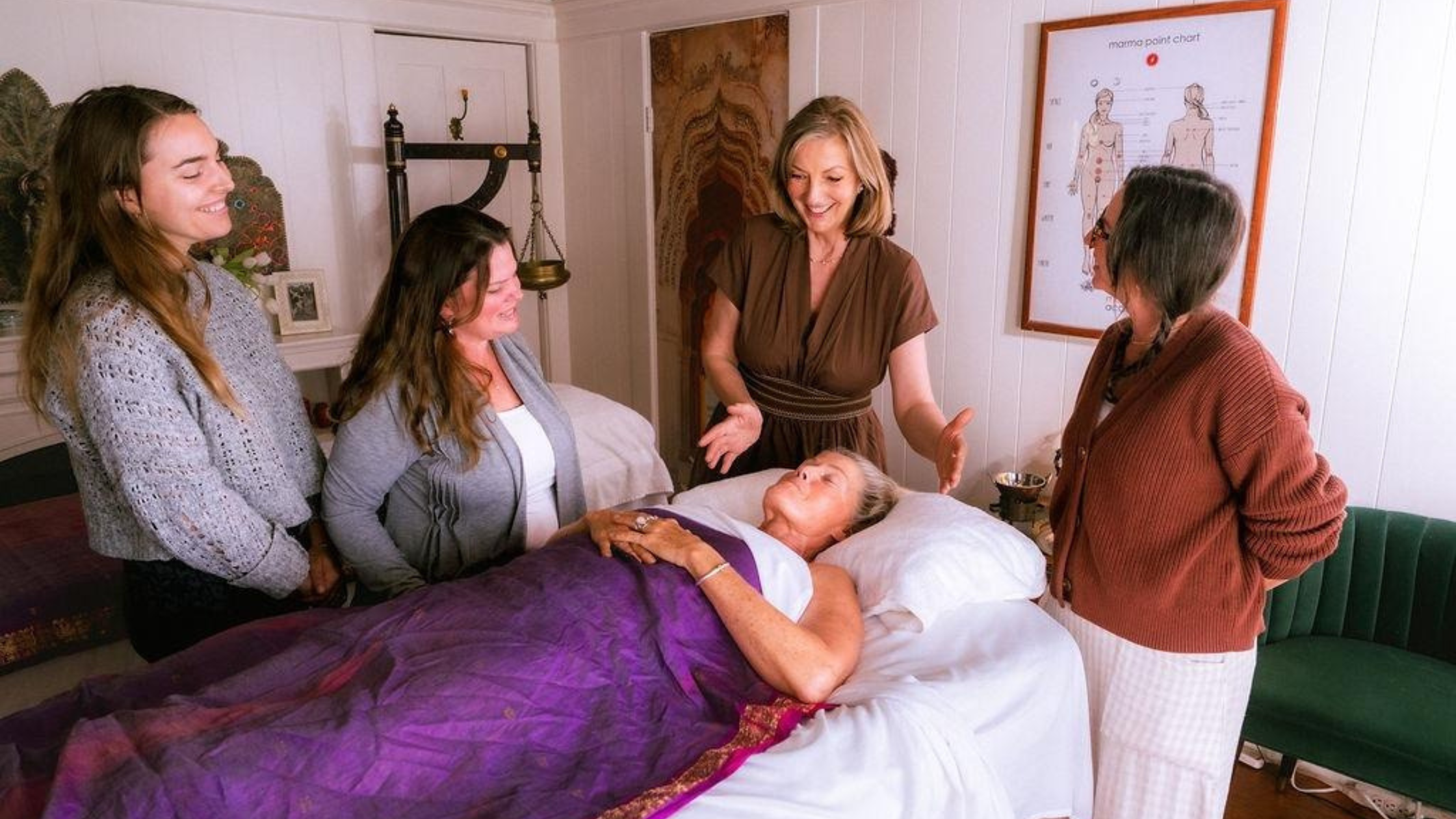
At the Maharani Spa and Clinic, Corinna and her team see only one patient a day, creating what she describes as a profound, unhurried four-hour experience. The guiding principle is simple: meet clients exactly where they are, and gently clear away whatever physical or mental obstacles and ama, stand in their path. Often, she finds that people aren't actually ready for a major detox the moment they walk in, because more basic foundations like hydration and diet haven't yet been established. That's why a deep consultation always comes first. When clients do arrive for treatment, they're settled into a lounge space where they can rest and process, because, in Corinna's experience, real transformation tends to happen in the quiet gaps between sessions, not in the sessions themselves. Nothing about the process, she insists, should ever feel rushed.
She's equally deliberate about who walks through the door in the first place. Her marketing and messaging are built to reflect the true depth of the work, specifically so they speak to people already searching for that authentic layer of healing. Because the message is honest about what the work actually involves, clients understand from the outset that this isn't something to check off a list, and the right clientele tends to find its way to her naturally.
What's AheadLooking at the next two to three years, Corinna is focused on a long-standing labor of love: a comprehensive clinical Panchakarma manual, five years in the making, that combines thirty-five years of her own clinical experience with the traditional knowledge passed down to her, adapted specifically for Western practitioners. Most existing textbooks come directly from India and don't always translate to a Western lifestyle; she sees this manual as a necessary tool to fill that gap.
She's also expanding her hands-on, live international training, believing strongly that Panchakarma has to be felt in the body to be truly understood, it isn't something that can be fully absorbed from a book. Her hope is to train practitioners who will, in turn, pass the knowledge on to their own students.
Zooming out to the next ten to twenty years, Corinna sees a field that keeps cycling between being hailed as the next big wellness trend and slipping quietly back into the background. But underneath that surface noise, she sees a real shift taking place, more people are weaving Ayurvedic philosophy into daily life, and even conventional medicine is starting to take notice.
Her concern is pace. Modern culture, built on short attention spans and bite-sized social content, tends to rush practices that were never meant to be quick. Those snippets can spark curiosity, she says, but short-term programs simply don't offer the clinical depth needed to guide someone through genuine, lasting change. True Ayurveda calls for dedicated, individualized care rather than generic, one-size-fits-all protocols, and she finds real hope in a rising generation of healers doing that deeper work.
For Corinna, this shift carries a larger stakes than personal wellness. She sees human health as inseparable from the health of the planet, record heatwaves, in her view, mirror the cellular and emotional inflammation happening inside people every day. No one is exempt, she notes, not even someone insulated by wealth; rising oceans and a shifting climate eventually reach everyone. Society, as she sees it, has fallen out of sync with the natural rhythms of sun and moon, Agni and lunar energy, and restoring balance means restoring the harmony between rest and activity. As the pace of the world accelerates, she believes people will increasingly look backward in order to move forward — reaching for the steadying anchor of circadian rhythm and ancient wisdom. Finding Ayurveda, she says, is its own kind of blessing.
Advice for the Next Generation
Asked what wisdom she'd offer students and new practitioners after thirty-five years in clinical practice, Corinna doesn't hesitate: find your passion within the knowledge, and work with the people who genuinely call out to you. She feels strongly about the importance of finding a niche; there's an instinct, when starting, to want to treat everyone and teach everyone, but trying to be everything to everyone tends to dilute a practitioner's power and effectiveness.
Whether someone is drawn to working with pregnant women, supporting people through midlife transitions, or helping those in recovery, her advice is the same: focus there. A community built from practitioners following their true calling, she believes, becomes a far more potent and impactful force for healing.
Corinna Maharani can be reached by email, ayurveda@maharani.us and more about her courses and certifications are available on her website www.maharaniayurveda.com
Alexeis Filipello is an Ayurvedic practitioner, licensed esthetician, culinary educator, and business owner with a background in culinary arts and holistic skincare. Her work integrates skin treatments and a food-as-medicine approach for optimal skin health.
Learn more at www.goldcitywellness.com